
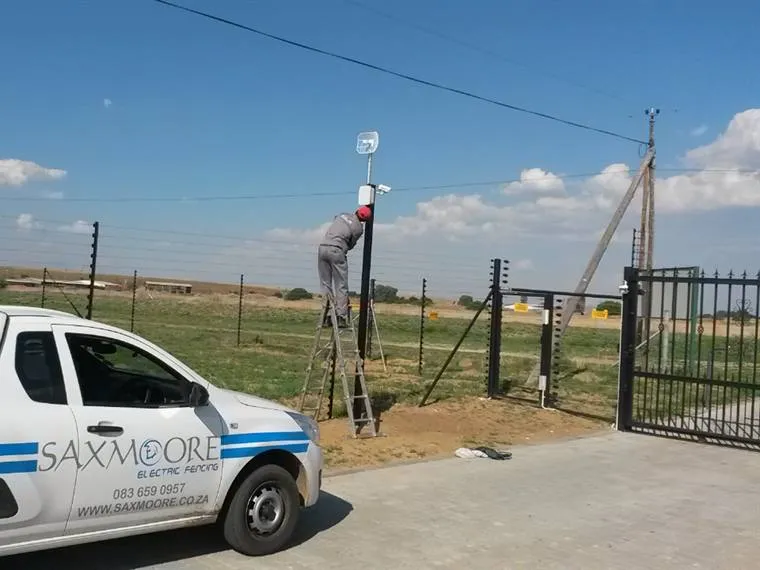
Two electric fences can look the same from the street and behave very differently. What decides it is the energiser, the wire, the brackets and insulators, the earth system and how the fence is split into zones.
Get those right and the fence deters, detects and keeps working for years. Get them wrong and you get low voltage, alarms in the rain and a fence that dies in the first storm.
The energiser is the heart of the fence, so choose it for security, not livestock
The energiser sends the pulse down the wires and watches for faults. For a home or business, use a security energiser, not a farm or livestock unit.
- Certified: energisers must be certified to SANS 60335-2-76. Ask to see the model on the certificate.
- Power for the length: a longer fence or more strands needs a stronger energiser. Your installer sizes it.
- A display: many show the fence voltage and name the fault, which saves a lot of guessing.
- Zones: two-zone energisers, such as Nemtek’s Druid 28LCD, tell you which section has the fault.
- Alarm outputs: so the fence can trigger your alarm and reach your armed response company.
- Battery backup: so it keeps working through power cuts.
- App alerts, if you want them: Nemtek Connect sends fence alarms to your phone. Its gateways come in 2G, 4G and Wi-Fi versions; choose 4G or Wi-Fi, because 2G and 3G are being switched off.
The wire: conductivity against strength
Aluminium carries the pulse well but is soft and breaks easily. Stainless steel is strong but conducts less. Some wires sit in between.
The right choice depends on the length of the fence, how exposed it is, and whether it has to stand up to knocks. We compare the options in our electric fence wire guide.
Brackets and posts hold the wires where the rules want them
On a wall, the fence sits on brackets. Away from a wall, it stands on its own posts.
- On-wall brackets can be straight up or angled. Angled brackets may lean out no more than 45°, and not over a neighbour’s property without their consent.
- Height: in a public area, the first live wire must be at least 1.5 m above the ground, or behind a barrier at least 1.5 m high.
- Freestanding fences need solid strainer posts at the ends and corners, with intermediate posts in between, so the wires stay tight.
- Tensioners keep each strand tight. A slack wire touches its neighbour in the wind and sets off the alarm.
Insulators and joints are where cheap fences leak
Every place a live wire meets a bracket or post, an insulator stops the pulse leaking away. Insulators sit in the sun for years, so they must be UV-stable. Cracked insulators are one of the most common reasons a fence loses voltage.
Joints matter too. Wire joined with the wrong connector, or twisted by hand, corrodes and causes faults later.
Planning a new fence? See electric fence installation.
The earth system: the part you can’t see does half the work
An electric fence only gives a proper shock with a good earth, because the pulse completes its circuit through the ground.
- Enough earth spikes for the energiser and the soil. Dry Highveld soil in winter needs more than people expect.
- Clean, tight connections on every spike.
- The installation standard, SANS 10222-3, asks for the earth lead to run in conduit, not buried, so it can be inspected.
Zones, gates, lightning protection and signs finish the job
- Zones: split a long fence so a fault shows where it is, instead of walking the whole boundary.
- Gates: electrified gates must open and close without shocking the person using them. A gate contact can tell the energiser when a gate is open.
- Lightning protection: a lightning diverter and surge protection give a storm surge a short way to the ground instead of through the energiser.
- Warning signs: yellow signs along public roads and paths, no more than 10 m apart, and at gates.
- No electrified razor or barbed wire. It’s not allowed.
Real jobs: 770 m in two zones on a Walkerville farm, and an 8-strand Meyerton fence on solar power with alarms to the owner’s phone.
Questions to ask an installer before you choose
- Which energiser, and why that size? You want a reason tied to your fence length and strands.
- How many zones? One zone is fine for a short wall; long boundaries need more.
- How will it link to my alarm and armed response?
- What lightning protection is included?
- Will I get the electric fence certificate when it’s done? Whoever installs a fence must make sure a certificate is issued, and only a registered installer can issue it. See the electric fence COC explained.
- What’s in the written quote, and what moves the price? For an idea of what drives the cost, read how much an electric fence costs.
How we plan a fence
You send us photos of the wall or boundary, or an outline from Google Maps, and tell us what the fence must do. We look at the site, measure, and give you a written quote with every part named. We never go over the quote without your OK. When the fence is up, we test every zone, link it to your alarm and armed response, and issue the certificate.
Send us a photo of the wall or boundary
WhatsApp us a photo or call 083 659 0957. We’re in Walkerville and install fences across the Midvaal and Joburg South.
Questions people ask
What are the main parts of an electric fence?
The energiser, the live wires, the brackets or posts with their insulators, the earth system, and the warning signs. Most security fences also have zones, gate contacts and lightning protection.
Which energiser is best for a home?
A security energiser certified to SANS 60335-2-76, sized for your fence’s length and strands, with alarm outputs and battery backup. A display and app alerts make faults easier to find.
How high must an electric fence be?
In a public area, the first live wire must be at least 1.5 m above the ground, or behind a barrier at least 1.5 m high. Your installer checks the rest of the standard.
Can I install an electric fence myself?
You can buy the parts, but the electric fence certificate can only be issued by an installer registered with the Department of Employment and Labour, and you’ll need it when you sell.
Do I need lightning protection on an electric fence?
Yes, especially on long or open fences. A lightning diverter, surge protection and a good earth protect the energiser, which is the part storms usually damage.