
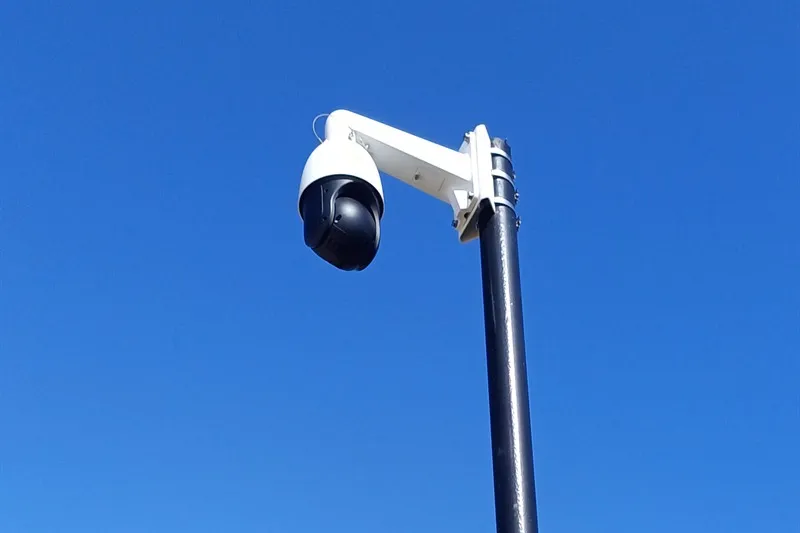
The main types of CCTV camera are dome, bullet, turret, PTZ (pan-tilt-zoom) and solar 4G cameras. They differ in shape, how far they see, how well they cope with weather and vandals, and what they need for power.
Choose by the job each camera must do: watch a door, read a number plate at the gate, cover a yard, or watch a boundary where there’s no power at all.
The five types, in one table
| Camera | What it is | Good for | Watch out for |
|---|---|---|---|
| Dome | A camera inside a dome-shaped cover | Under eaves, entrances, indoors; harder to see which way it points | The dome can catch glare from its own night lights if it gets dirty |
| Bullet | A long, tube-shaped camera on a bracket | Driveways, yards and long views; visible, so it deters | Easier to knock or turn if mounted low |
| Turret (eyeball) | A ball-shaped camera in a cup, no cover | Most outdoor spots; little glare at night | Visible and reachable if mounted low |
| PTZ | A camera that pans, tilts and zooms on command | Big yards, parking areas and farms, where one camera must cover a lot | Only sees where it’s pointing at that moment |
| Solar 4G | A camera with its own solar panel, battery and SIM | Gates, boundaries and outbuildings with no power or Wi-Fi | Needs sun, a mobile signal and a sensible recording plan |
Megapixels decide how much detail you get, and how much storage you need
More megapixels mean more detail, so you can zoom into a recording and still see a face or a number plate. They also mean bigger files.
- For a general view of a yard or a room, a mid-range resolution is usually enough.
- To identify a face at a door or a plate at the gate, use a higher resolution, a narrower lens, or a camera placed closer.
- More pixels need more recorder storage for the same number of days.
The lens matters as much as the pixels. A wide lens sees more but shows less detail far away. A varifocal lens can be set to the right width on the day.
At night: infrared or colour
Most cameras switch to black-and-white infrared at night. Some, such as Hikvision’s ColorVu range, use a small white light or a very sensitive sensor to record in colour at night. Colour helps you describe clothes and cars.
Thermal cameras see heat across long, open perimeters
A thermal camera shows heat instead of light, so it sees in complete darkness and across open ground where an ordinary camera’s night light doesn’t reach. We do thermal camera perimeter intrusion protection with Hikvision thermal cameras, for farms and large sites.
A real job: auto-tracking colour PTZ and thermal cameras on an Eikenhof farm.
Want help choosing? See CCTV systems and installation.
No power at the gate or the boundary? Solar 4G cameras
A solar 4G camera carries its own solar panel and battery and sends video over the mobile network, so it needs no cable trench. It suits farm gates, long boundaries, outbuildings and building sites.
We’ve put a solar camera pole on a freestanding electric fence at an off-grid site; see the solar camera pole project. Hikvision says its solar cameras can run for about a week without sun. Plan for a few grey days in a row in summer, and put the panel where it gets sun all day.
Recorders, apps and keeping the footage
Most systems record to a recorder (an NVR for network cameras, a DVR for older coaxial ones) with a hard drive inside. You watch live and play back on a phone app.
- Size the hard drive for how many days you want to keep.
- Put the recorder somewhere hidden or locked, so it can’t be carried off with the evidence.
- Give it backup power so it keeps recording through power cuts.
- Link the cameras to your alarm or electric fence, so you can open them and see what’s happening when it goes off.
Point cameras at your property, not your neighbour’s
Footage of people who can be identified is personal information under POPIA. Point cameras at your own property and access points. A complex or estate should have a written CCTV policy: where cameras go, signs, how long footage is kept and who may see it.
How we plan a camera system
You WhatsApp us photos or a rough plan of the property and tell us what you need to see. We suggest the camera type and position for each spot, quote it in writing, install it, set up the recorder and the app, and show you how to find and save footage. We install and service Hikvision cameras and recorders. We never go over the quote without your OK.
Send us photos of what you want to watch
WhatsApp us photos of your property or call 083 659 0957. We install CCTV for homes, farms and businesses across Johannesburg and the Midvaal.
Questions people ask
What type of CCTV camera is good for outside?
Turret and bullet cameras are the usual choice outdoors: weatherproof, clear at night, and visible enough to deter. Use a PTZ for a large yard, and a solar 4G camera where there’s no power.
What is the difference between a dome and a bullet camera?
A dome sits under a rounded cover and is hard to read which way it points; a bullet is a long tube on a bracket, more visible and better for long views like a driveway.
Do CCTV cameras work without electricity?
Wired cameras need power, so they stop in a power cut unless the system has backup power. Solar 4G cameras carry their own panel and battery and keep working.
What is a PTZ camera?
A camera that can pan left and right, tilt up and down and zoom in on command, from the app or on a programmed tour. It covers a big area with one camera, but only sees where it’s pointing.
How many megapixels do I need for CCTV?
Enough to see what you need: a general view needs less, identifying faces or number plates needs more, or a closer camera. More megapixels need more storage.