
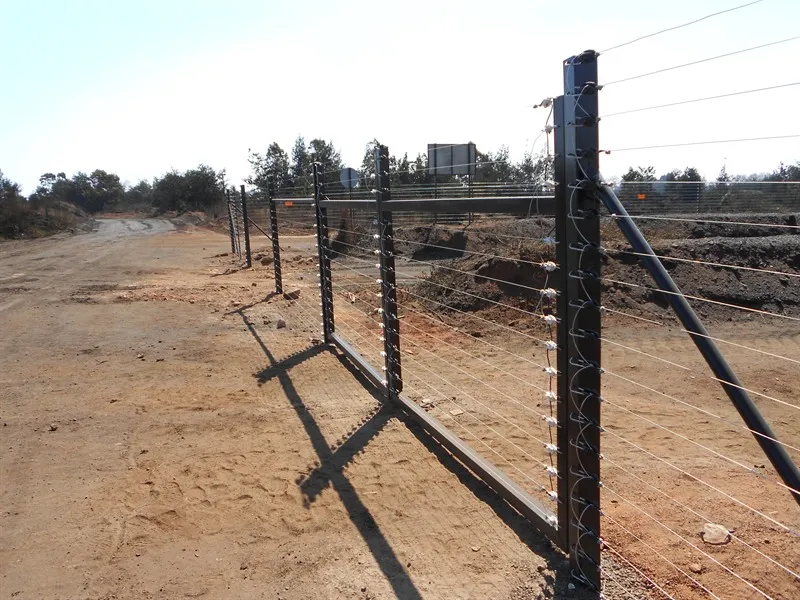
An electric fence on an industrial or commercial site has three jobs: keep people out, show exactly where someone tried to get in, and keep working without anyone thinking about it.
The standard (SANS 10222-3) sets the heights, the signs and the certificate. The site decides the rest: how the fence is zoned, where the alarms go, and who checks it.
The standard: SANS 10222-3
- Height: the first live wire at least 1.5 m above public ground, or behind a 1.5 m barrier. Low-voltage monitored bottom sections are one way to do it.
- Signs: yellow warning signs no more than 10 m apart, and at gates, access points and corners.
- The energiser must have a SANS 60335-2-76 test certificate.
- No electrified razor or barbed wire.
- Earth leads in conduit above ground, as the 2023 edition of SANS 10222-3 asks.
The certificate: every new fence, every alteration
Every new electric fence, and every alteration, needs an electric fence certificate. Only an installer registered with the Department of Employment and Labour can issue it, and it’s separate from your electrical wiring COC. Landlords, insurers and head office often ask to see it. See electric fence certificates.
A real job: a steel yard’s fence brought up to standard, with 13 earth-spike kits, two lightning diverters and 60 extra warning signs to bring the spacing down to 10 m, then certified with a drawing of the fence.
Zones, so you know where to look
A long boundary is split into zones that alarm on their own. When one goes off, the guards or the technician go straight to that section instead of walking the whole line. Multi-zone energisers handle long runs.
A real job: 1,800 m of electric fence moved to an inner fence line at an industrial site, rewired in galvanised wire and certified.
Monitoring: the alarm must reach someone
- The energiser alarms through your alarm panel to your control room or armed response company, by radio, GSM or IP.
- No 2G gateways: 2G and 3G are being switched off, with a national target of the end of 2027.
- Cameras on the gates and weak points, and outdoor beams inside the line, show what set the fence off.
The fence type: freestanding or on top
- Freestanding high-security fences for open boundaries and yards.
- On top of walls, palisade and clear view mesh, on brackets that lean inwards, never over a neighbour without consent.
- Upgrades of old fences, often reusing the posts.
A real job: an 8-strand fence on the walls of an office park, with the energiser locked in an outdoor enclosure that has a window, so it can be checked without opening it.
Earthing and lightning on long runs
Long fences need earth spikes along the line, an earth grid at the energiser and lightning diverters. Dry or rocky ground needs more spikes. A weak earth is a common reason a long fence reads low or misses alarms.
Site rules: inductions, permits and shutdown windows
Industrial sites have their own safety rules. Inductions, permits, PPE and working inside shutdown windows add time, so they belong in the plan and the quote from the start.
Maintenance: a fence nobody checks fails quietly
On a monthly visit we:
- Log the voltage on every zone, so you can see a trend.
- Test the earth and walk the line: wires, insulators and vegetation.
- Test each zone’s alarm (cut, short and earth), the sirens and the link to your control room.
- Test the batteries and chargers under load.
- Check the gate contacts, the lightning diverters and the warning signs.
You get a written report after every visit that you can file for your insurer or head office. Fault response is during office hours, Monday to Friday, 08:00 to 17:00. See maintenance plans.
What to send for a quote
WhatsApp us a pin or a site plan and a few photos of the boundary. We survey the site and price the fence and the maintenance contract per site, in writing. We never go over the quote without your written OK.
WhatsApp us your site or call 083 659 0957. See commercial and industrial electric fencing. We work across the East Rand, Joburg South and the Midvaal.
Questions people ask
What are the requirements for an industrial electric fence?
It must be built to SANS 10222-3: the first live wire at least 1.5 m above public ground or behind a barrier, warning signs at most 10 m apart, a certified energiser, no electrified razor wire, and an electric fence certificate.
Does a business need an electric fence certificate?
Yes, for every new fence and every alteration. It must be issued by an electric fence installer registered with the Department of Employment and Labour.
Why split a commercial fence into zones?
So each section alarms on its own, and the guards or the technician go straight to the right part of the fence instead of walking the whole line.
How often should a commercial electric fence be checked?
Many business sites have a monthly maintenance visit that tests every zone, the earth, the alarms and the batteries, with a written report after each visit.
Can the fence alarm go to our control room?
Yes. The energiser alarms through your panel to your control room or armed response company by radio, GSM or IP. Avoid 2G gateways, as 2G and 3G are being switched off.