
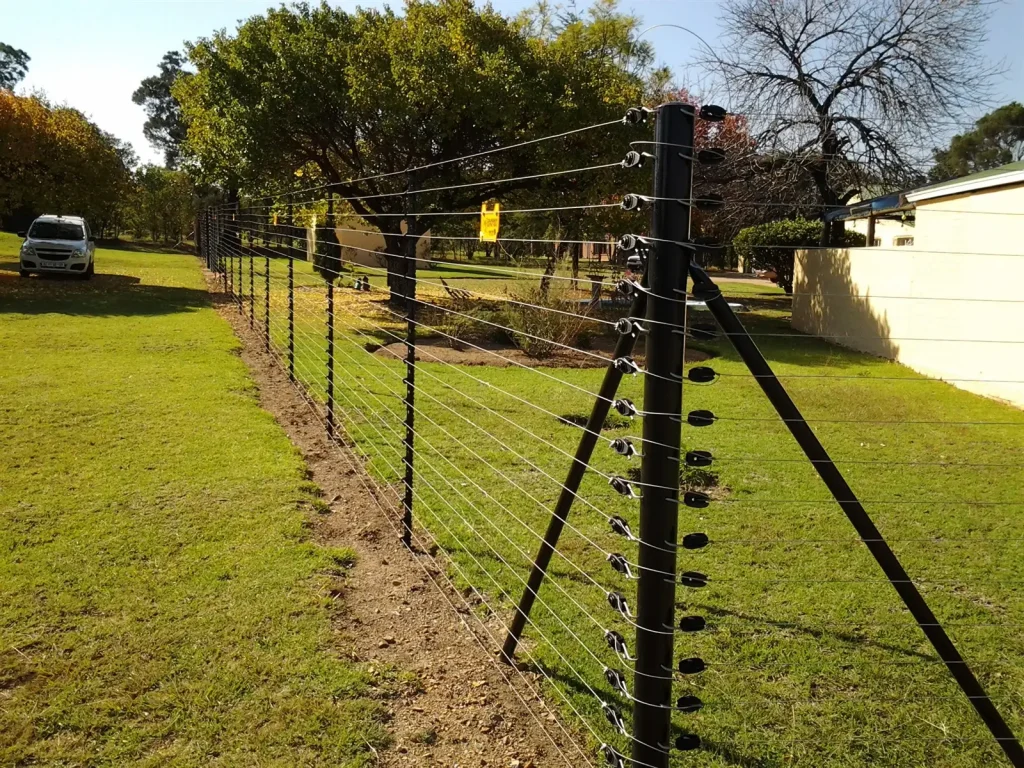
An electric fence around a smallholding or plot is a different job from one on a house wall. The lines are long, the ground is open, there are gates and driveways, and the far corner may have no power at all.
Sort out six things before you ask for quotes: the boundary, what the fence must do, the zones, the power, the gates, and how you’ll hear about a fault. Then every installer is quoting on the same fence.
Start with the boundary: measure it on Google Maps
You don’t need a tape measure to start. Open Google Maps, switch to satellite view, and right-click to measure the line you want fenced. Send that outline, or a screenshot of it, with your quote request.
- Mark where the fence must go, and where it can’t (a neighbour’s wall, a stream, a servitude).
- Mark the gates, driveways and any spot where vehicles cross.
- Mark the house, outbuildings and where your power is.
On a smallholding in Walkerville, Henley on Klip, De Deur or Three Rivers, the boundary is often hundreds of metres. That length drives everything else.
Decide what the fence must do: keep people out, keep animals in, or both
A security fence and a livestock fence are built differently.
- Security: keep people out and raise an alarm when someone tries. Usually more strands, higher, with alarm outputs to your house alarm and armed response.
- Livestock: keep animals in. Fewer strands at animal height, often a farm energiser.
- Both: common on plots. The security fence runs on the boundary; paddock fencing inside can run off a separate energiser.
Be clear about this up front. It changes the energiser, the height, the strand count and the price.
Freestanding or on a wall
Most smallholdings use a freestanding fence: its own posts, with strong strainer posts at the ends and corners and intermediate posts in between. Where there’s already a wall or a palisade, the electric fence can go on top of it or alongside it.
In a public area, such as along a road, the first live wire must be at least 1.5 m up, or behind a barrier at least 1.5 m high, with yellow warning signs no more than 10 m apart.
See farm and smallholding electric fencing, and real jobs: a 2 m, 20-strand freestanding fence on a Walkerville smallholding and 770 m in two zones on a Walkerville farm.
Split a long fence into zones
On a long fence, one zone means one alarm and a long walk to find the fault. Split it, and the energiser tells you which section to check.
- A zone per side of the property is a common start.
- Gates and driveways often get their own zone.
- Two-zone energisers, and setups with more than one energiser, make this easy.
Power, lightning and earthing on a long line
- Power: the energiser needs mains power with a battery backup, so it keeps working through power cuts. Where there’s no mains at that point, a solar panel and battery can run it.
- Lightning: long fences on open ground take the most surges in storm season. A lightning diverter and surge protection guard the energiser.
- Earthing: dry Highveld soil in winter makes earthing harder. A long fence needs a proper earth system, or it gives a weak shock and false alarms.
A real job: an 8-strand Meyerton fence on solar power, with alarms to the owner’s phone.
Gates, driveways and the people who use them
Every gate is a weak point and a daily nuisance if it’s done badly.
- Electrified gates must open and close without shocking whoever uses them.
- A gate contact can tell the energiser, and you, when a gate is left open.
- Think about who uses each gate: staff, deliveries, livestock, the borehole contractor.
Gate motors are a target on open properties: how we replaced a stolen one in Eikenhof and locked it in.
Decide how you’ll hear about a fault
- The alarm siren on site, and a link to your armed response company.
- Your phone: Nemtek Connect sends fence alarms to an app, through a 4G or Wi-Fi gateway (not 2G, which is being switched off).
- Cameras at the gate: where there’s no power or Wi-Fi, a solar 4G camera can watch the gate, and you see it on your phone.
How we quote a smallholding fence
Send us your Google Maps outline, the gates, and what the fence must do. We look at the site, walk the line, and give you a written quote that names the energiser, the strands, the zones and the lightning protection. We never go over it without your OK. When the fence is up, we test every zone and issue the electric fence certificate.
Send us your boundary from Google Maps
WhatsApp us your boundary or call 083 659 0957. We’re in Walkerville and fence smallholdings and plots across the Midvaal.
Questions people ask
What kind of electric fence do I need for a smallholding?
Usually a freestanding security fence on the boundary, split into zones, with lightning protection and alarm outputs. If you also keep animals, paddock fencing inside can run off its own energiser.
Can an electric fence run on solar power?
Yes. Where there’s no mains power, a solar panel and battery can run the energiser. Your installer sizes the panel and battery for the energiser and for cloudy days.
How many zones should a smallholding fence have?
Enough that a fault shows you where to look. A zone per side of the property is a common start; gates and driveways often get their own.
Do I need an electric fence certificate on a smallholding?
Yes. A new fence needs one when it’s installed, and you’ll need a current one when you sell. Only a registered installer can issue it, once the fence passes its test.
How do I get a quote without a site visit first?
Send your boundary outline from Google Maps, photos of the gates, and what the fence must do. That’s enough for a first idea; the written quote follows once the line has been walked.