
The short answer: an energiser, live wires, the supports that hold them, and a good earth
An electric fence is an energiser, live wires, the brackets, posts and stays that hold the wires up, the insulators that keep the pulse on the wires, and an earth system that completes the circuit. Warning signs, gate contacts, a siren and lightning protection finish the job.
Of all of them, earthing is the part we see fail the COC inspection most often, followed by missing stays and supports, missing warning signs and no lightning diverter.
Book an electric fence COC inspection, or WhatsApp us photos of your fence
On this page:
- The parts of an electric fence, and what goes wrong with each
- The energiser, HT cable and lightning diverter
- Brackets, strainers and stays
- Earthing, in detail
- What fails the COC
The parts of an electric fence, and what goes wrong with each
| Part | What it does | What goes wrong |
|---|---|---|
| Energiser | Sends the pulse down the live wires and raises the alarm when the fence is cut, shorted or earthed | Too small for the fence, no test certificate, or killed by lightning |
| HT cable | Insulated high-voltage cable that carries the pulse from the energiser to the fence, and under gates | Insulation breaks down with age and leaks to the ground |
| Live wires (strands) | Carry the pulse along the fence | Slack, broken or badly joined wire, or the wrong wire for the job |
| Brackets | Hold the strands on top of a wall, upright or angled | Too far apart, knocked loose, or leaning over a neighbour’s wall |
| Posts and Y standards | Hold up a freestanding fence | Too few, so the strands sag between them |
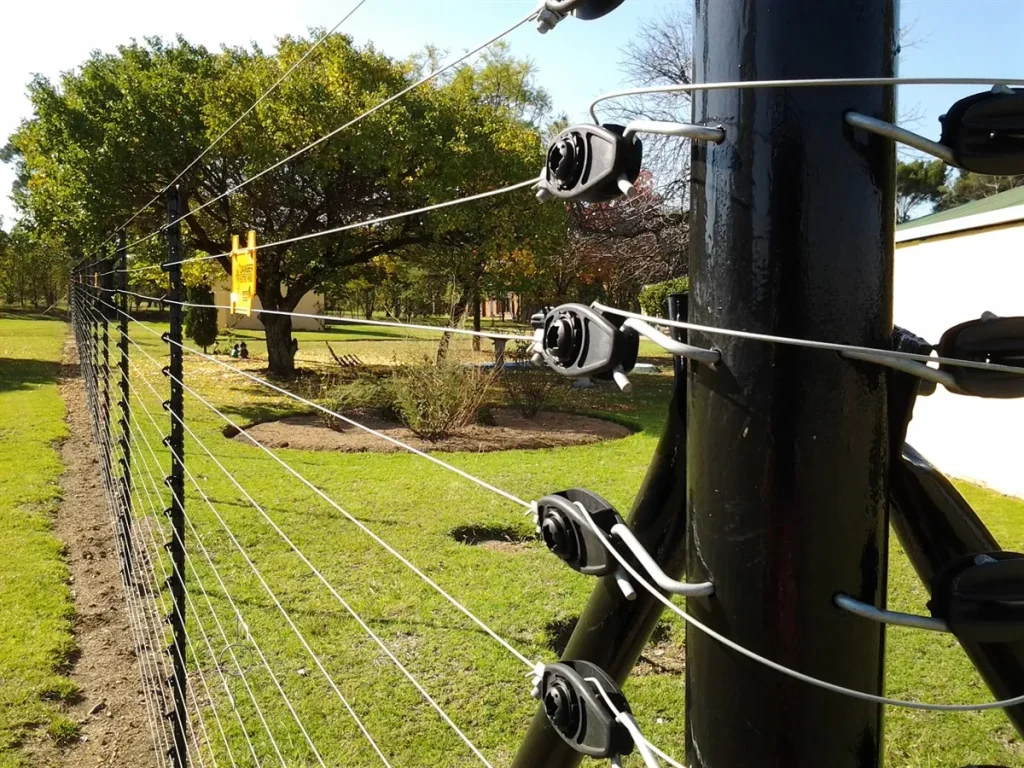
| Strainers and stays | Strainers take the pull of the wire at ends, corners and gates; stays brace them | Too few stays, so strainers lean and the wires go slack |
| Insulators (bobbins) | Keep the pulse on the wire wherever it meets a bracket or post | Cracked by the sun, so voltage leaks away, worst in the rain |
| Tensioners and springs | Keep each strand tight | Left slack, so wires touch in the wind and set off the alarm |
| Joints and line clamps | Join lengths of wire without losing the pulse | Hand-twisted joints that corrode and cause faults later |
| Earth spikes and earth wire | Complete the circuit through the ground | Too few spikes, dry soil, loose clamps, earth leads buried |
| Lightning diverter | Gives a surge a short path to the ground before it reaches the energiser | Missing, or damaged by an old strike |
| Gate contacts | Tell the energiser when a gate is opened | Missing, so a forced gate goes unnoticed |
| Siren and strobe | Sound and flash when the fence alarms | Disconnected, or nobody hears them |
| Warning signs | Warn the public that the fence is electrified | Missing along the road, over gates or at corners |
The wire has its own guide: aluminium, stainless steel or galvanised.

Our job: a strainer post with its insulators, Walkerville.
The energiser, HT cable and lightning diverter are the power end of the fence
The energiser sits in a weatherproof box, and HT cable carries the pulse out to the fence. Where the fence crosses a gate, the HT cable runs under it in conduit, as on a Meyerton fence with three gates.
The lightning diverter goes on the fence side, before the energiser, with its own earth spike. More on electric fence energisers and lightning protection.
Brackets, strainers and stays keep the wires where the standard wants them
On a wall, the strands sit on brackets, upright or angled outwards no more than 45°, on your side of the wall. On an open boundary, the fence stands on its own posts.
Strainers take the pull of the wire at the ends, the corners and the gates. Each one needs stays to brace it, or it leans and the wires go slack. Too few stays and supports is the next most common COC failure we see after earthing.
At a Glenvista home, we added brackets to bring the gaps down to 3 m, and eight stays at the tension points, before we could certify the fence.
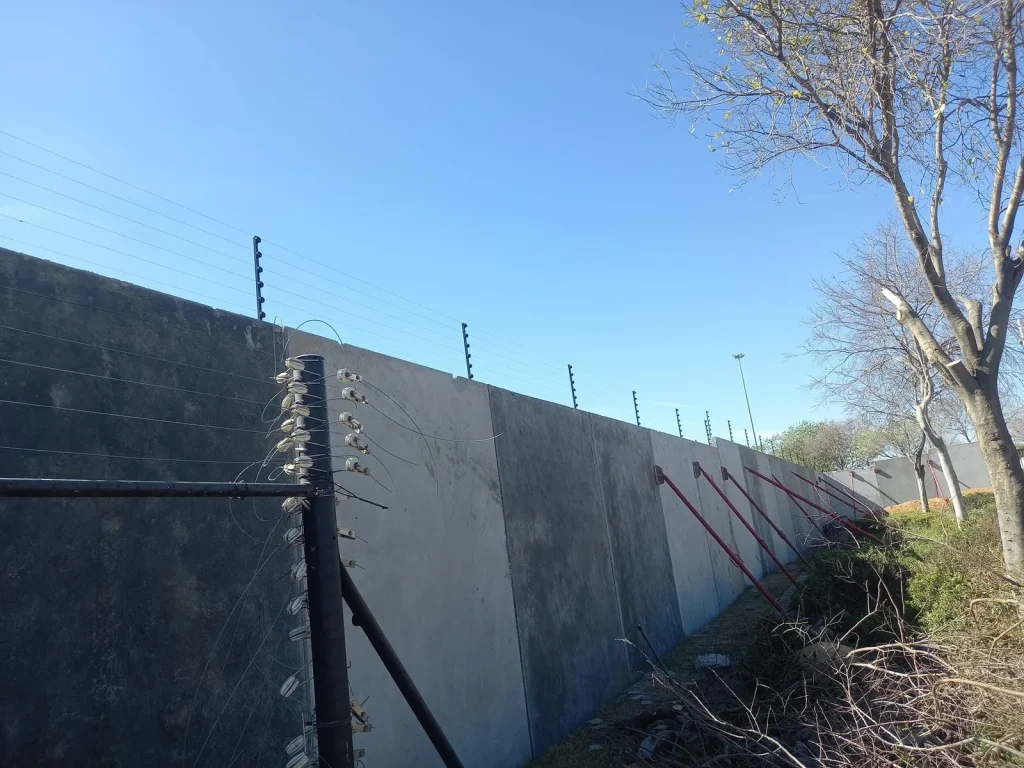
Our job: a braced strainer bracket where a wall-top fence turns a corner, Centurion.
Earthing is the part that fails most, because nobody sees it
The pulse leaves the energiser along the live wires, passes through whoever touches the fence, and returns through the ground to the earth spikes. If the earth is weak, the circuit is weak: the shock is feeble, the fence reads low, and the alarm goes off in dry weather.
This is what a good earth has, and what we check for:
- Enough earth spikes for the energiser and the soil. The energiser’s maker sets a minimum number and spacing, and dry or rocky ground needs more.
- Spikes driven deep enough and spaced apart, joined to the energiser’s earth terminal with insulated cable.
- Clean, tight clamps on every spike. One corroded clamp can undo the rest.
- Earth leads that run in conduit where they leave the ground, not buried, so an inspector can see them. The 2023 edition of SANS 10222-3 asks for this.
- An earth grid at the energiser. On our recent wall-top jobs that has been a grid of three spikes, with the fence also earthed every 30 m along its length.
Dry Highveld soil carries the current poorly in winter, so a fence that tested well in summer can start false-alarming in a dry spell. More spikes, or spikes in damper ground, usually sort it out.
We test the earth on every COC inspection and every maintenance visit, along with each zone’s voltage.
Book an electric fence COC inspection, or WhatsApp us photos of your fence
After earthing, stays, signs and lightning diverters fail the COC most
- Earthing comes first: too few spikes, loose clamps, or earth leads buried instead of running in conduit.
- Then stays and supports, when strainers have no stays or the brackets are too far apart, so posts lean and wires sag.
- Then warning signs, missing along the road, over the gates or at the corners. Along a public road or path they go no more than 10 m apart.
- Then the lightning diverter, when there isn’t one.
The full inspection checklist is in the electric fence COC explained. When a fence fails, we tell you what needs fixing and the price first; once it’s fixed, we test it again and issue the certificate.
Buying parts yourself? The certificate still has to come from a registered installer
You can buy electric fence parts and put a fence up yourself, but the fence must meet SANS 10222-3, and only an electric fence installer registered with the Department of Employment and Labour may issue its certificate. You’ll need that certificate when you sell.
If you’d rather we built it, see electric fence installation, choosing an electric fence and what drives the price.
Send us photos of your fence, and we’ll tell you what it needs
WhatsApp photos of the fence and the energiser, or call 083 659 0957. We build and certify electric fences across Johannesburg, Pretoria and Centurion, the East Rand and the Midvaal.
Questions people ask
What parts does an electric fence need?
An energiser, HT cable, live wires, brackets or posts, strainers and stays, insulators, tensioners, an earth system of spikes and wire, warning signs, gate contacts, a siren and a lightning diverter.
How many earth spikes does an electric fence need?
Enough for the energiser and the soil. The energiser’s maker sets a minimum number and spacing, and dry or rocky ground needs more. On recent wall-top jobs we’ve put an earth grid of three spikes at the energiser and earthed the fence every 30 m.
Will an electric fence work without an earth spike?
Not properly. The shock completes its circuit through the ground, so without a good earth the fence reads low, gives a weak shock and false-alarms, and it won’t pass the COC inspection.
Do you need insulators on an electric fence?
Yes, everywhere a live wire meets a bracket, post or strainer. Without them the pulse leaks into the support. Insulators cracked by the sun are a common cause of low voltage and alarms in the rain.
Where do electric fence warning signs have to go?
Along every public road or path, no more than 10 m apart, and at every gate, access point and corner. They’re yellow and at least 100 × 200 mm.
Why do electric fences fail the COC?
Earthing most often: too few spikes, or earth leads buried instead of in conduit. After that come too few stays and supports, missing warning signs, and no lightning diverter.